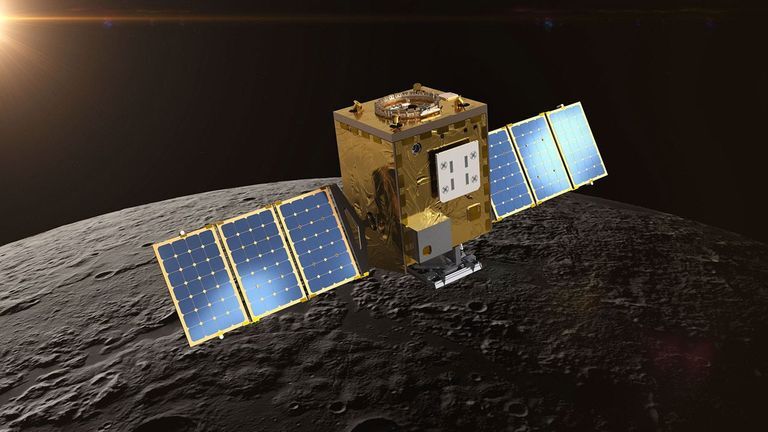
- The Lunar Trailblazer mission failed due to a critical software error that misaligned its solar panels.
- Compounding the primary error, faulty on-board management systems prevented any chance of recovery.
- The $72 million loss highlights the inherent risks and specific challenges in 'Class D' low-cost space missions.
- NASA and Lockheed Martin are reportedly implementing lessons learned to enhance future mission protocols and testing.
The Fatal Software Flaw
On February 26, 2025, NASA's Lunar Trailblazer spacecraft, designed to map water on the Moon, lifted off with high hopes. However, just a day later, mission managers lost contact, and the probe was never heard from again. A comprehensive report by a NASA review panel has since revealed the devastating cause: a fundamental error in the spacecraft's pointing software. This critical flaw caused the solar panels, vital for power generation, to orient 180 degrees away from the sun, effectively starving the spacecraft of energy.
Cascading Failures and Fault Management
The problem wasn't singular. The panel's investigation uncovered a cascade of “many erroneous on-board fault management actions.” These subsequent software issues exacerbated the initial pointing error, making it incredibly difficult, and ultimately impossible, for ground control to rectify the situation. This scenario echoes past space mission failures, such as the 1999 Terriers mission, which also suffered from solar panel pointing issues combined with other systemic problems. Experts emphasize that complex system failures are rarely due to a single cause but rather a “cascading series of different failures.”
The Low-Cost Mission Conundrum
Built by Lockheed Martin, Lunar Trailblazer was categorized as a 'Class D' mission — a designation for lower-cost projects that inherently accept higher risks. The NASA panel specifically noted that Lockheed Martin did not adequately test the crucial solar panel pointing software pre-launch. While both NASA and Lockheed Martin acknowledged learning from the failure, the incident sparks a wider debate about the acceptable level of risk in such missions. “What class D was supposed to mean is that you were taking a big risk of not getting the science that was as high precision as you were planning on. It didn't mean the whole darn thing wouldn't work,” states NASA veteran Scott Hubbard. This loss underscores that “cheap failure is no good for anybody,” especially for scientists whose careers are tied to these missions.
Specs & Data: Class D Missions Overview
| Feature | Lunar Trailblazer | Escapade (Example of Beneficiary) |
|---|---|---|
| Mission Type | Class D (Low-Cost, Higher Risk) | Class D (Low-Cost, Higher Risk) |
| Primary Objective | Map water on the Moon | Study how solar wind affects Martian atmosphere (pair of spacecraft) |
| Launch Date | February 26, 2025 | November 2025 (probes won't reach Mars until Sept 2026) |
| Key Failure Point | Software error in solar panel pointing; fault management failures | Initial ground antenna pointing error (resolved) |
| Cost | $72 million | Not specified, implied low-cost |
| Status | Mission Failed (Lost contact) | Successfully launched, en route to Mars (post-launch issues resolved) |
| Lessons Learned | Critical for future Class D missions | Benefited from Trailblazer lessons with extra scrutiny |
Market Impact
The loss of Lunar Trailblazer sends ripples across the space industry, particularly concerning the design and execution of 'low-cost' missions. It will undoubtedly lead to a re-evaluation of software testing protocols, fault management architectures, and pre-launch verification processes, even for missions with tighter budgets. Future Class D missions, like UC Berkeley's Escapade to Mars, have already received “extra scrutiny” thanks to the Trailblazer's experience, demonstrating an immediate shift in industry practice. This incident underscores the importance of balancing cost-effectiveness with robust engineering and exhaustive testing to ensure fundamental mission success, aligning institutional objectives, contracting, and technical approaches more tightly.
The Verdict
The Lunar Trailblazer failure serves as a stark reminder that in space exploration, software integrity and robust fault management are not negotiable, regardless of a mission's cost classification. While the pursuit of lower-cost missions is crucial for expanding scientific reach, the lessons from this $72 million loss emphasize the need for mitigated, understood risks rather than “foolish risk.” This unfortunate event, though devastating for the scientific community, provides invaluable insights that will undoubtedly shape the development and testing of future spacecraft, enhancing the overall reliability and success rate of upcoming space endeavors.
